

the love hotel.You may have already noticed them while walking around Osaka or Tokyo. Some look surprisingly luxurious, some are colorful and playful, and others are so discreet that you might walk straight past without realizing what they are.
And if you’re planning to meet someone during your trip, you may eventually find yourself wondering:
“Wait… how am I actually supposed to use one of these?”
Don’t worry. ♡
Love hotels are very normal in Japan, but the system can definitely feel confusing if you’ve never used one before.
The good news is that once you understand a few basics, they’re much easier to use than they look.
So here is my guide for first-time international visitors.
- First-Time Cheat Sheet
- 1. What Exactly Is a Love Hotel?
- 2. How Do You Check In?
- 3. REST or STAY?
- 4. Can You Reserve a Love Hotel?
- 5. Why Are There So Many Love Hotels Together?
- 6. Friday and Saturday Nights Need a Little More Planning
- 7. How Do You Find a Good Love Hotel?
- 8. How Do You Pay?
- 9. Should You Bring Your Passport?
- 10. Can You Leave and Come Back?
- 11. What’s Inside a Love Hotel Room?
- 12. Should We Meet Outside or Should You Check In First?
- 13. What If I Don’t Speak Japanese?
- 14. What If I Have Absolutely No Idea Which Hotel to Choose?
- 15. If You’re Meeting Me, Here’s the Simple Version
- Love Hotels Aren’t as Complicated as They Look
- And If You’re Meeting Me in Osaka… ♡
- Contact Sui Directly ♡
- Useful Links
First-Time Cheat Sheet
If you only remember five things, remember these:
- Choose a love hotel area, not just one specific hotel.
- Check the REST or STAY time and total price before entering.
- On Friday and Saturday nights, keep a backup hotel in mind or make a reservation.
- Bring a physical credit card and a little cash.
- If you’re visiting Japan from overseas, keep your passport with you.
1. What Exactly Is a Love Hotel?
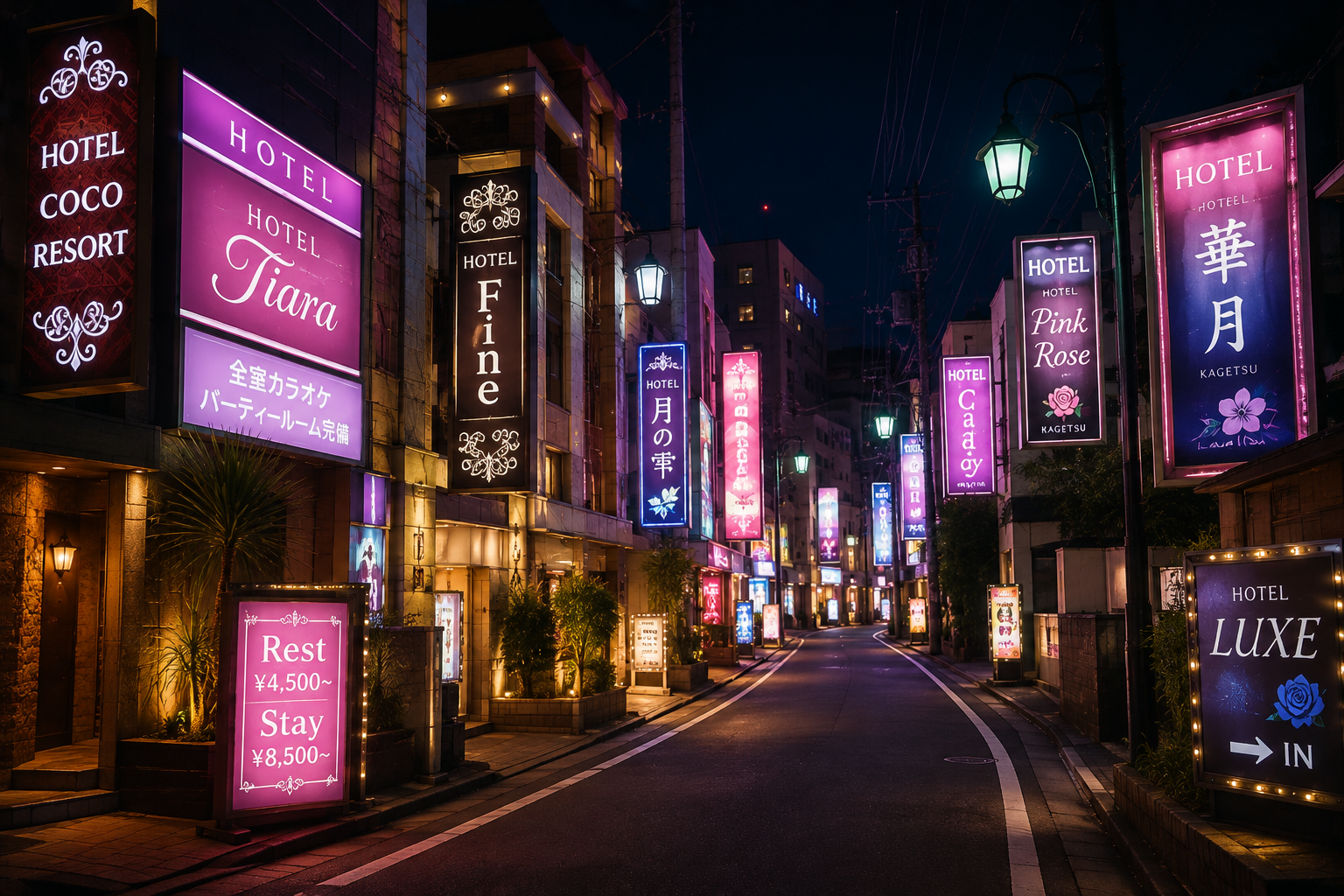
A love hotel is a hotel designed primarily to give couples a private room.
One of the biggest differences from a conventional hotel is that you usually don’t need to stay overnight.
You’ll commonly see terms such as:
REST
A shorter stay, usually for a few hours.
STAY
An overnight stay.
You may also see Free Time or Service Time, which usually gives you a longer block of time during certain hours.
The important thing to understand is that there is no universal schedule or pricing system.
Every hotel is different.
A REST plan at one hotel may be completely different from the hotel next door, and prices can change depending on the time, day of the week, weekend, or holiday.
So always check the price board or hotel website before choosing your room.
2. How Do You Check In?
This is probably the first moment when a foreign visitor thinks:
“What am I supposed to do now?” 😆
Many love hotels are designed to make check-in relatively private.
You might walk inside and find a large illuminated panel or touchscreen showing photos of the available rooms.
Choose a room you like and follow the instructions.
Some hotels use automatic systems, while others have a front desk.
There are also more conventional, service-oriented hotels where you speak with staff just like you would at a normal hotel.
A good example is Hotel Bali An Resort.
Bali An has locations including Shinjuku and Namba/Shinsaibashi, and it has a proper front desk, advance reservations, and a more resort-hotel-like atmosphere.
It’s clean, comfortable, and personally I think it’s a very nice option, especially if the traditional love hotel system makes you nervous.
Just remember that Bali An is not necessarily representative of how every Japanese love hotel works.
3. REST or STAY?
If you only need the room for a few hours, you’ll usually be looking at a REST plan.
If you’re staying overnight, you’ll want STAY.
But there’s something important to know if you’re planning a late-night meeting.
Many love hotels switch over to overnight STAY plans later in the evening. Around midnight is common, but the exact time depends on the hotel.
So if you already know you’ll be spending time together very late at night, booking an overnight STAY can sometimes be easier.
Before choosing your room, check:
- How long you can use the room
- The total price
- When your REST period ends
- When STAY pricing begins
- What happens if you go over your allotted time
That last one is worth checking!
You don’t want to be enjoying yourselves, forget about the time, and suddenly discover that you’ve entered an extension period.
4. Can You Reserve a Love Hotel?
Sometimes yes, sometimes no.
Some love hotels accept reservations for short REST visits, while others still operate mainly on a walk-in basis.
Overnight STAY plans are often easier to reserve in advance.
Hotels such as Bali An also allow advance reservations for day use and overnight stays.
But there is one piece of advice I think is more useful than choosing one perfect hotel:
Choose the area, not just the hotel.
Love hotels tend to be concentrated in certain parts of Japanese cities.
So instead of thinking:
“I absolutely have to stay at Hotel A.”
Think:
“I’ll go to this love hotel area. Hotel A looks good, but I have a couple of backup options too.”
Then, if your first choice is full, you simply try the next hotel.
This makes everything much less stressful.
5. Why Are There So Many Love Hotels Together?
If you’ve walked through certain parts of Shinjuku or Namba, you may have wondered why there are suddenly hotels everywhere.
Love hotels tend to cluster in particular areas because hotel development and adult-oriented businesses are subject to zoning and local regulations.
For you as a visitor, however, there’s a very practical advantage:
You have options.
If one hotel is full, there may be another one only a minute away.
This is why choosing a love hotel district is often more practical than becoming attached to one specific property.
6. Friday and Saturday Nights Need a Little More Planning
Friday and Saturday nights can be busy.
If you arrange to meet someone directly outside one specific love hotel, there is always a possibility that the hotel will be full by the time you arrive.
On busy nights, either reserve a hotel in advance or choose an area with several nearby options.
Having a second and third hotel in mind means there’s no need to panic if your first choice has no rooms.
You just go next door. 😆
7. How Do You Find a Good Love Hotel?
You can absolutely use Google Maps, but Japanese hotel-search websites can be even more useful.
One popular option is Happy Hotel.
You can browse love hotels by area, look at photos and hotel information, and search for properties that accept reservations.
Even if you don’t read Japanese, photos, maps, prices, and room information can give you a much better idea of what you’re choosing.
I recommend checking:
- Location
- Room photos
- Reviews
- Bathroom photos
- REST and STAY times
- Prices
- Payment methods
- Whether reservations are available
And don’t choose only by price.
If you’re going to spend a few hours together, the atmosphere of the room matters too. ♡
8. How Do You Pay?
Payment systems vary.
Depending on the hotel, you might pay at the front desk or use an automatic payment machine.
And yes, sometimes the automatic payment machine is actually inside your room.
Very Japanese. 😆
In my experience, credit cards are accepted at most modern love hotels in major cities, so you generally shouldn’t have much trouble unless you’re visiting an older or more remote property.
However, I would still recommend bringing your physical credit card.
Don’t rely entirely on Apple Pay, Google Pay, or another contactless payment method, because tap-to-pay may not be supported everywhere.
Having a little Japanese cash as backup is also never a bad idea.
9. Should You Bring Your Passport?
If you’re visiting Japan from overseas, keep your passport with you.
For overnight accommodation, Japanese rules require foreign guests who do not have an address in Japan to provide information including their nationality and passport number, and accommodation providers may request to see and copy the passport.
So if you’re staying overnight and the hotel asks for your passport, don’t be alarmed.
It’s a normal part of staying at accommodation in Japan as an international visitor.
The simple rule is: if you’re traveling in Japan, just keep your passport with you anyway.
10. Can You Leave and Come Back?
Check before you leave.
Don’t automatically assume that every love hotel works like a conventional hotel where you can walk in and out whenever you want.
Re-entry policies vary depending on the property and plan.
If you think you’ll want drinks, snacks, cigarettes, or anything else during your time together, it can be easier to stop at a convenience store before checking in.
Japan has convenience stores everywhere, so this is usually very easy.
And honestly, choosing snacks together before going to the hotel can be kind of fun too. ♡
11. What’s Inside a Love Hotel Room?
This is one of the fun parts.
The quality varies enormously, but many modern Japanese love hotels are much nicer than international visitors expect.
Depending on the hotel and room, you might find:
- A large bed
- A spacious bathroom
- Bath amenities and toiletries
- A large television
- A refrigerator
- Drinks or room service
- Hair and beauty amenities
- Entertainment equipment
Some hotels go much further.
You may find large baths, elaborate interiors, karaoke, massage chairs, themed rooms, saunas, or other unusual facilities.
Others simply look like stylish modern hotel rooms with a little more privacy.
Personally, I always think it’s worth looking at the room photos beforehand.
The room becomes part of the experience, after all. ♡
12. Should We Meet Outside or Should You Check In First?
Both can be possible depending on the hotel.
You can arrange to meet outside and enter the hotel together.
Or, depending on the property’s rules, one person may be able to check in first and have the other person join afterward.
If you plan to do this, it’s a good idea to confirm the hotel’s visitor and re-entry policy first, because rules vary by property.
If we’re meeting outside, remember that your first-choice hotel might be full, especially on Friday and Saturday nights.
Choosing an area with several love hotels nearby makes this much easier.
If you prefer to check in first and the hotel allows it, just send me your room number once you’re settled.
For some first-time visitors, getting the unfamiliar check-in part finished before meeting can actually feel more relaxing. ♡
13. What If I Don’t Speak Japanese?
Please don’t worry too much.
In major tourist and nightlife areas such as Shinjuku in Tokyo and Namba in Osaka, international visitors are much more common than they used to be.
English ability will still vary from hotel to hotel, of course.
Google Translate can be your friend.
And honestly, a lot of the process is visual anyway.
Pointing at the room you want works surprisingly well. 😆
14. What If I Have Absolutely No Idea Which Hotel to Choose?
Imagine this:
You’re standing in Namba.
You open Google Maps.
There are love hotels everywhere.
And now you’re thinking:
“Sui… which one am I supposed to choose?!”
First, relax. 😆
If you’re arranging your meeting through Made In Japan (MIJ), you can ask the Concierge about your meeting arrangements.
For example:
“I’m looking for a love hotel around Namba. Do you have any recommendations?”
If you’re nervous about the hotel or meeting process, tell them.
MIJ is specifically used by international visitors, so asking questions in English is completely normal.
You can also check the MIJ FAQ before your appointment.
15. If You’re Meeting Me, Here’s the Simple Version
If you’ve read this entire article and you’re still thinking,
“Sui, I’m confused.”
Then remember just this:
- Choose an area with several love hotels.
- Check room photos, prices, and REST/STAY times beforehand.
- On busy nights, have a backup hotel or make a reservation.
- Bring a physical credit card and keep your passport with you.
- If you check in before me and the hotel allows it, send me your room number.
That’s enough.
You do not need to become an expert in Japanese love hotels before meeting me.
Love Hotels Aren’t as Complicated as They Look
The first time feels intimidating mostly because the system is unfamiliar.
But once you understand the basic idea, it’s actually pretty simple:
Choose an area → find an available hotel → choose your room and plan → check in → relax → pay according to the hotel’s system → check out.
And perhaps the most useful thing to remember is:
Don’t fall in love with one hotel before you arrive.
Fall in love with the area. 😆
If your first choice is full, there’s probably another interesting room waiting nearby.
And If You’re Meeting Me in Osaka… ♡

Maybe there’s a reason you found this article in the first place.
Maybe the person you’re thinking about meeting is me.
I’m Sui, the girl behind this blog.
If you’re coming to Osaka and you’d like to meet me, please don’t let something as simple as an unfamiliar hotel system make you nervous.
You don’t need perfect Japanese.
You don’t need to understand every mysterious button at the entrance.
And you definitely don’t need to become a Japanese love hotel expert before our date. 😆
Ask questions.
Tell us which area is convenient for you.
And if you arrive before me, just let me know where you are.
The hotel is only the setting.
What matters much more to me is that once we finally meet, you can stop thinking about logistics, relax, and enjoy our time together. ♡
See you in Osaka!
Contact Sui Directly ♡
Useful Links
Hotel Bali An Resort
A comfortable, service-oriented option with locations including Shinjuku and Namba.
Happy Hotel
Search Japanese love hotels, room information, and reservable properties.
Made In Japan (MIJ)
Official website.
MIJ FAQ
Booking, hotels, payments, and other frequently asked questions.
MIJ Delivery & Travel Information
Current delivery areas, travel arrangements, and fees.
Love hotel systems, prices, REST/STAY times, reservation policies, payment methods, visitor rules, and re-entry rules vary by property and may change. Please check the individual hotel’s current information before visiting.
-scaled.png)
コメント